Made With Calcium Alginate Casing
Auto-generated content. This description was generated automatically and is pending editorial review. Inaccuracies are possible. Found a mistake? Contact us.
What it is
Calcium alginate is a salt derived from alginic acid, which is extracted from brown seaweed. It is produced by reacting sodium alginate (another seaweed derivative) with calcium chloride. The resulting calcium alginate forms a gel that can be used to create casings.
Why it's used
Manufacturers use calcium alginate to create edible casings for processed meats like sausages and hot dogs. These casings help hold the product's shape during cooking and processing, and they are typically edible and do not need to be removed before consumption.
Health notes
Calcium alginate is generally recognized as safe (GRAS) by the U.S. Food and Drug Administration (FDA) for use as a food additive. It is considered a dietary fiber and is not known to have adverse health effects at typical consumption levels. International bodies like JECFA (Joint FAO/WHO Expert Committee on Food Additives) have evaluated alginates and their salts, and EFSA (European Food Safety Authority) has also assessed their safety.
Allergen info
Calcium alginate is derived from seaweed and is not one of the nine FDA major allergens. It does not contain gluten.
Products containing Made With Calcium Alginate Casing
Compare products → JENNIE.O
Turkey Breakfast Sausage Links
135kcal
16.7Protein
8.3Fat
0Carbs
Jennie-O Turkey Store, Inc.
Turkey Breakfast Sausage Links, Turkey
125kcal
17.9Protein
6.2Fat
0Carbs
Ralph and Paul Adams, Inc.
All Natural Pork Sausage
High in saturated fat — 35% DV per serving
407kcal
11.9Protein
39.0Fat
1.7Carbs
Jones Dairy Farm
Pork Sausage
High in saturated fat — 35% DV per serving
407kcal
13.6Protein
39.0Fat
1.7Carbs
Jennie-O Turkey Store, Inc.
Turkey Breakfast Sausage Links, Turkey Breakfast
125kcal
17.9Protein
6.2Fat
0Carbs
JENNIE.O
Turkey Breakfast Sausage Links
135kcal
16.7Protein
8.3Fat
0Carbs
Jennie-O Turkey Store, Inc.
Turkey Breakfast Sausage Links, Turkey
125kcal
17.9Protein
6.2Fat
0Carbs
Ralph and Paul Adams, Inc.
All Natural Pork Sausage
High in saturated fat — 35% DV per serving
407kcal
11.9Protein
39.0Fat
1.7Carbs
Jones Dairy Farm
Pork Sausage
High in saturated fat — 35% DV per serving
407kcal
13.6Protein
39.0Fat
1.7Carbs
Jennie-O Turkey Store, Inc.
Turkey Breakfast Sausage Links, Turkey Breakfast
125kcal
17.9Protein
6.2Fat
0Carbs
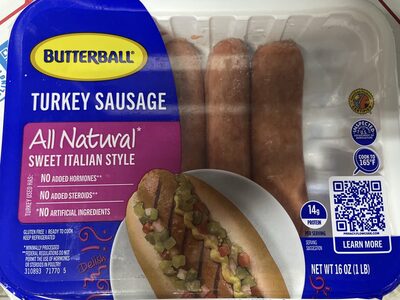 Butterball, LLC
Lean Sweet Italian Style Turkey Sausage
High in sodium — 24% DV per serving
High in cholesterol — 20% DV per serving
167kcal
17.8Protein
8.9Fat
1.1Carbs
Butterball, LLC
Lean Hot Italian Style Turkey Sausage
High in sodium — 24% DV per serving
High in cholesterol — 20% DV per serving
167kcal
17.8Protein
8.9Fat
0Carbs
JONES DAIRY FARM
Pork Sausage Links, All Natural Ingredients in a Calcium Alginate Casing, Mild, .8oz., 1/10 lb. , Fully Cooked ,Certified Gluten- Free
348kcal
13.0Protein
34.8Fat
4.3Carbs
Butterball, LLC
Lean Sweet Italian Style Turkey Sausage
High in sodium — 24% DV per serving
High in cholesterol — 20% DV per serving
167kcal
17.8Protein
8.9Fat
1.1Carbs
Butterball, LLC
Lean Hot Italian Style Turkey Sausage
High in sodium — 24% DV per serving
High in cholesterol — 20% DV per serving
167kcal
17.8Protein
8.9Fat
0Carbs
JONES DAIRY FARM
Pork Sausage Links, All Natural Ingredients in a Calcium Alginate Casing, Mild, .8oz., 1/10 lb. , Fully Cooked ,Certified Gluten- Free
348kcal
13.0Protein
34.8Fat
4.3Carbs