Auto-generated content.
This description was generated automatically and is pending editorial review.
Inaccuracies are possible. Found a mistake? Contact us.
Source
Not animal-derived
Allergen
No
Role in food
Green beans are primarily used as a vegetable side dish, either plain or prepared …
What it is
Green beans are the immature pods of various cultivars of the common bean plant (*Phaseolus vulgaris*). They are typically grown in warm climates and harvested when the pods are young and tender. After harvesting, they may be sold fresh, frozen, or canned.
Why it's used
Green beans are primarily used as a vegetable side dish, either plain or prepared with seasonings and sauces. Manufacturers include them in canned vegetables, frozen vegetable mixes, and soups for their nutritional value and familiar flavor.
Health notes
Green beans are a source of dietary fiber, vitamins, and minerals. They are not subject to specific FDA regulations as a food additive. International bodies like the WHO/FAO Joint Expert Committee on Food Additives (JECFA) and the European Food Safety Authority (EFSA) have evaluated many food ingredients, but green beans as a whole food are not typically evaluated in the same way as isolated additives. They are generally considered a healthy part of a balanced diet.
Allergen info
Green beans are not a major allergen. They are not derived from milk, egg, fish, shellfish, tree nuts, peanuts, wheat, soy, or sesame. They do not contain gluten.
Note:
This site presents label data from USDA FoodData Central for general information. It is not medical advice.
Check the package label; formulations change.
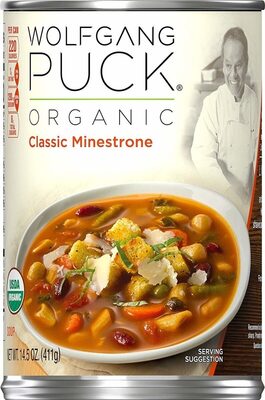 CAMPBELL SOUP COMPANY
Wp Org Clssc Minestrn 14.5Oz
High in sodium — 56% DV per serving
53kcal
2.5Protein
1.0Fat
8.6Carbs
CAMPBELL SOUP COMPANY
Wp Org Clssc Minestrn 14.5Oz
High in sodium — 56% DV per serving
53kcal
2.5Protein
1.0Fat
8.6Carbs