Auto-generated content.
This description was generated automatically and is pending editorial review.
Inaccuracies are possible. Found a mistake? Contact us.
Source
Not animal-derived
Allergen
No
Role in food
Manufacturers add sliced black olives to foods for their distinct, mild flavor and texture. …
What it is
Sliced black olives are the fruit of the olive tree, typically the Manzanilla or Mission varieties, commonly grown in the Mediterranean and California. After harvesting, olives are cured to remove bitterness and then typically processed with ferrous gluconate or ferrous lactate to achieve a uniform black color before slicing.
Why it's used
Manufacturers add sliced black olives to foods for their distinct, mild flavor and texture. They are frequently found in pizzas, salads, dips, spreads, and as a topping for various savory dishes.
Health notes
Black olives are generally recognized as safe (GRAS) by the FDA for use in food. They are a source of healthy fats and antioxidants. The Joint FAO/WHO Expert Committee on Food Additives (JECFA) has evaluated olives and their components, and the European Food Safety Authority (EFSA) has also assessed related compounds. Evidence does not suggest adverse health effects from typical consumption.
Allergen info
Olives are not one of the nine major allergens recognized by the FDA, nor are they a source of gluten.
Note:
This site presents label data from USDA FoodData Central for general information. It is not medical advice.
Check the package label; formulations change.
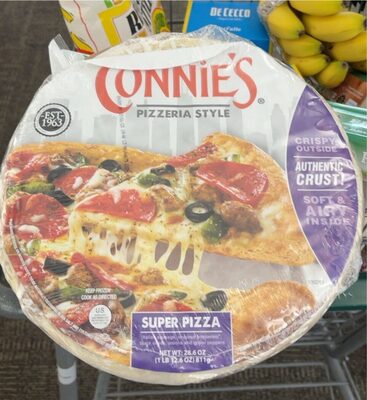 Palermo Villa Inc.
Pizzeria Style Super Pizza Italian Sausage, Uncured Pepperoni, Black Olives, Onions And Green Peppers, Pizzeria Style
High in sodium — 30% DV per serving
High in saturated fat — 35% DV per serving
244kcal
9.6Protein
13.3Fat
22.2Carbs
Palermo Villa Inc.
Pizzeria Style Super Pizza Italian Sausage, Uncured Pepperoni, Black Olives, Onions And Green Peppers, Pizzeria Style
High in sodium — 30% DV per serving
High in saturated fat — 35% DV per serving
244kcal
9.6Protein
13.3Fat
22.2Carbs