Auto-generated content.
This description was generated automatically and is pending editorial review.
Inaccuracies are possible. Found a mistake? Contact us.
Source
Animal-derived
Allergen
No
Role in food
Manufacturers use confectioner's glaze as a protective coating or glossing agent. It gives candies, …
What it is
Confectioner's glaze is a food-grade shellac, a resin secreted by the lac bug (Kerria lacca). It is typically processed to remove insect parts and purified before use in food.
Why it's used
Manufacturers use confectioner's glaze as a protective coating or glossing agent. It gives candies, chocolates, and baked goods a shiny appearance and can also act as a moisture barrier.
Health notes
In the U.S., confectioner's glaze is generally recognized as safe (GRAS) by the FDA when used according to good manufacturing practices. Regulatory bodies like JECFA and EFSA have evaluated shellac and its derivatives. At typical consumption levels, it is not associated with adverse health effects.
Allergen info
Confectioner's glaze is not derived from any of the 9 FDA major allergens. It does not contain gluten.
Note:
This site presents label data from USDA FoodData Central for general information. It is not medical advice.
Check the package label; formulations change.
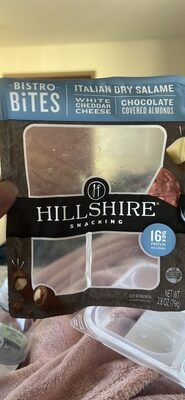 The Hillshire Brands Company
Italian Dry Salame, White Cheddar Cheese, Chocolate Covered Almonds Bistro Bites, Italian Dry Salame, White Cheddar Cheese, Chocolate Covered Almonds
High in sodium — 40% DV per serving
High in saturated fat — 50% DV per serving
High in cholesterol — 22% DV per serving
405kcal
20.2Protein
31.6Fat
10.1Carbs
The Hillshire Brands Company
Italian Dry Salame, White Cheddar Cheese, Chocolate Covered Almonds Bistro Bites, Italian Dry Salame, White Cheddar Cheese, Chocolate Covered Almonds
High in sodium — 40% DV per serving
High in saturated fat — 50% DV per serving
High in cholesterol — 22% DV per serving
405kcal
20.2Protein
31.6Fat
10.1Carbs