Auto-generated content.
This description was generated automatically and is pending editorial review.
Inaccuracies are possible. Found a mistake? Contact us.
Source
Not animal-derived
Allergen
No
Role in food
Carbonates are commonly used as leavening agents in baked goods, producing carbon dioxide gas …
What it is
Carbonate refers to a compound containing the carbonate ion (CO3^2-). In food, it is often found in the form of salts like sodium carbonate, potassium carbonate, or calcium carbonate. These are typically produced industrially through chemical processes.
Why it's used
Carbonates are commonly used as leavening agents in baked goods, producing carbon dioxide gas when heated or reacted with acid, which helps dough rise. They can also function as acidity regulators and sometimes as anti-caking agents in powdered products.
Health notes
In the US, certain carbonates like calcium carbonate are Generally Recognized As Safe (GRAS) by the FDA for use in food. The Joint FAO/WHO Expert Committee on Food Additives (JECFA) has evaluated many carbonate salts, often establishing acceptable daily intakes. Evidence does not suggest adverse health effects from typical dietary intake.
Allergen info
Carbonates are not derived from any of the nine FDA major allergens and do not contain gluten.
Note:
This site presents label data from USDA FoodData Central for general information. It is not medical advice.
Check the package label; formulations change.
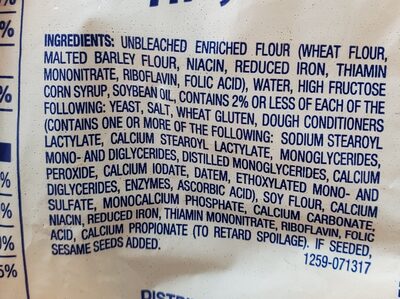 Flowers Foods, Inc.
Hamburger Enriched Buns
High in sodium — 20% DV per serving
289kcal
8.4Protein
4.2Fat
54.2Carbs
Flowers Foods, Inc.
Hamburger Enriched Buns
High in sodium — 20% DV per serving
289kcal
8.4Protein
4.2Fat
54.2Carbs