Auto-generated content.
This description was generated automatically and is pending editorial review.
Inaccuracies are possible. Found a mistake? Contact us.
Source
Not animal-derived
Allergen
No
Role in food
Manufacturers use whole grain amaranth flour as a nutrient-rich flour alternative in baked goods …
What it is
Whole grain amaranth flour is made from amaranth, a pseudocereal crop grown for its edible seeds. The seeds are ground into a fine powder, similar to how wheat is milled into flour. Amaranth is native to the Americas and has been cultivated for thousands of years.
Why it's used
Manufacturers use whole grain amaranth flour as a nutrient-rich flour alternative in baked goods like breads and muffins. It can also be used as a thickener in sauces or as a binder in vegetarian products. Its slightly nutty flavor is a desirable characteristic in many food applications.
Health notes
Whole grain amaranth flour is generally recognized as safe (GRAS) by the FDA for use in food. It is a source of protein, fiber, and various micronutrients. Regulatory bodies like JECFA and EFSA have evaluated amaranth and its components. Research suggests that whole grains, including amaranth, can be part of a healthy diet.
Allergen info
Amaranth is not one of the nine major allergens recognized by the FDA. It is also naturally gluten-free.
Note:
This site presents label data from USDA FoodData Central for general information. It is not medical advice.
Check the package label; formulations change.
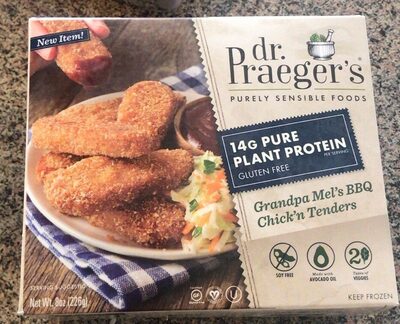 Dr. Praeger's Sensible Foods, Inc.
Grandpa Mel's BBQ Chick'N Tenders, Grandpa Mel's BBQ
High in sodium — 21% DV per serving
262kcal
17.5Protein
11.2Fat
22.5Carbs
Dr. Praeger's Sensible Foods, Inc.
Grandpa Mel's BBQ Chick'N Tenders, Grandpa Mel's BBQ
High in sodium — 21% DV per serving
262kcal
17.5Protein
11.2Fat
22.5Carbs