Auto-generated content.
This description was generated automatically and is pending editorial review.
Inaccuracies are possible. Found a mistake? Contact us.
Source
Unknown
Not yet classified by editors
Allergen
No
Role in food
Manufacturers use egg flavor to enhance or impart an egg-like taste in foods where …
What it is
Egg flavor is a flavoring substance designed to mimic the taste and aroma of cooked eggs. It can be derived from natural sources like eggs themselves, or created synthetically using various chemical compounds. The specific ingredients and processes used can vary widely depending on the manufacturer.
Why it's used
Manufacturers use egg flavor to enhance or impart an egg-like taste in foods where real eggs are not used or are not the primary flavor component. It is commonly found in processed breakfast items, baked goods, and savory snacks to provide a more authentic or appealing flavor profile.
Health notes
Egg flavor is generally recognized as safe (GRAS) by the FDA when used as a food flavoring. Regulatory bodies like JECFA and EFSA have evaluated many flavoring substances, but specific evaluations for 'egg flavor' as a general term are not always detailed. At typical consumption levels, it is not associated with adverse health effects. Research on the long-term impact of consuming a wide variety of artificial flavorings is ongoing.
Allergen info
If derived from real eggs, egg flavor would be considered an allergen. However, many synthetic egg flavors are not derived from eggs and therefore would not be a major allergen. Consumers should check product labels for specific ingredient information.
Note:
This site presents label data from USDA FoodData Central for general information. It is not medical advice.
Check the package label; formulations change.
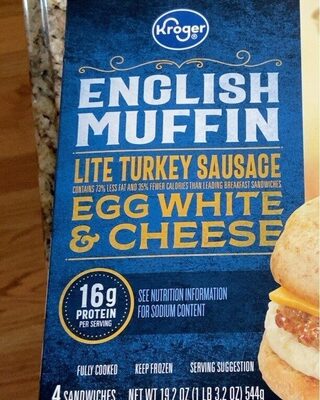 The Kroger Co.
Egg White & Cheese English Muffin Lite Turkey Sausage, Egg White & Cheese
High in sodium — 33% DV per serving
191kcal
11.8Protein
5.2Fat
23.5Carbs
The Kroger Co.
Egg White & Cheese English Muffin Lite Turkey Sausage, Egg White & Cheese
High in sodium — 33% DV per serving
191kcal
11.8Protein
5.2Fat
23.5Carbs