Unbleached Unbromated Enriched Flour
Auto-generated content. This description was generated automatically and is pending editorial review. Inaccuracies are possible. Found a mistake? Contact us.
What it is
Unbleached unbromated enriched flour is a type of flour, typically made from wheat, that has not been treated with chemical bleaching agents or potassium bromate. 'Enriched' means that certain nutrients, such as iron and B vitamins (folic acid, riboflavin, niacin, thiamine), are added back to the flour after the milling process removes them.
Why it's used
This flour is a fundamental ingredient used to provide structure and texture in a wide variety of baked goods. It is commonly found in breads, cakes, cookies, pastries, and other processed foods.
Health notes
Flour itself is a food ingredient, not a food additive, and is generally recognized as safe. The enrichment of flour with essential nutrients is a public health initiative supported by the FDA to prevent nutrient deficiencies. Potassium bromate, which is absent in 'unbromated' flour, is permitted by the FDA for use as a dough conditioner; however, JECFA has stated it is not appropriate for use as a flour treatment agent and has not set an acceptable daily intake (ADI). California's Food Safety Act (AB 418) bans potassium bromate in food from 2027.
Allergen info
This ingredient is derived from wheat, which is one of the nine major food allergens identified by the FDA. It also contains gluten.
Products containing Unbleached Unbromated Enriched Flour
Compare products →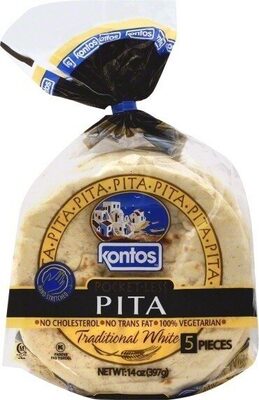 Kontos Foods Inc.
Traditional White Pocket-Less Pita, Traditional White
291kcal
10.1Protein
5.7Fat
50.6Carbs
Kontos Foods Inc.
Traditional White Pocket-Less Pita, Traditional White
291kcal
10.1Protein
5.7Fat
50.6Carbs
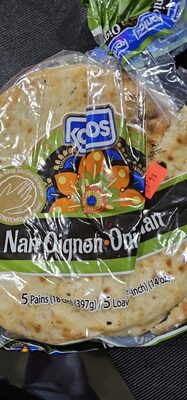 Kontos Foods Inc.
Onion Flatbread
291kcal
10.1Protein
5.7Fat
49.4Carbs
Miller Bakery
Miller Baking Co, Marble Snack Rye Bread
250kcal
7.1Protein
0Fat
50Carbs
Jumbo Foods, Inc.
Smoked Turkey Pita
High in sodium — 84% DV per serving
High in saturated fat — 30% DV per serving
223kcal
11.5Protein
6.5Fat
28.4Carbs
Kontos Foods Inc.
Onion Flatbread
291kcal
10.1Protein
5.7Fat
49.4Carbs
Miller Bakery
Miller Baking Co, Marble Snack Rye Bread
250kcal
7.1Protein
0Fat
50Carbs
Jumbo Foods, Inc.
Smoked Turkey Pita
High in sodium — 84% DV per serving
High in saturated fat — 30% DV per serving
223kcal
11.5Protein
6.5Fat
28.4Carbs
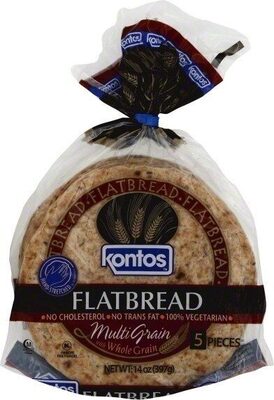 Kontos Foods Inc.
Multigrain With Whole Grain Flatbread, Whole Grain
291kcal
10.1Protein
6.3Fat
49.4Carbs
Kontos Foods Inc.
Multigrain With Whole Grain Flatbread, Whole Grain
291kcal
10.1Protein
6.3Fat
49.4Carbs
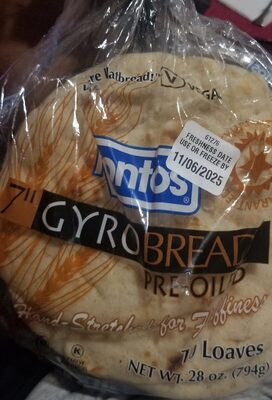 Kontos Foods Inc.
Pre-Oiled 7"" Gyro Bread Loaves
291kcal
10.1Protein
5.7Fat
50.6Carbs
Kontos Foods Inc.
Pre-Oiled 7"" Gyro Bread Loaves
291kcal
10.1Protein
5.7Fat
50.6Carbs